Monday, February 11, 2019

February 10, 2019: Triple Creek Nature Preserve

Was a rainy night then stopped about 6am  - but I did not expect to find much due to the mild cold of winter.  I was surprised to find a Phidippus regius with a valentine heart on her dorsal aspect of her abdomen

Cuckoo Wasp - Folded 

Cuckoo Wasp roaming about my finger

Phidippus regias (?) emerging from her egg sac

New spider for me

Newly hatched spiderlings: A tangle of legs

Egg Sac hanging from a small twig

Hanging egg sac with recently emerged spiderlings

A patch of volunteer watermelons

This was hiding under one of the watermelons:  Phidippus regis

Looking at me

A valentine Phidippus regius - masquerading as Phidippus valentinas  - what a surprise!!!

Wednesday, January 30, 2019

January 30, 2019: Progress with post processing DSLR deep space objects

GIMP and processing astrophotographs

The main idea is to use levels to expand the histogram and "bring out" the features hidden in the almost black.  One way is to use Colors:Levels and move the center pointer to the right edge of the histogram, save and reopen moving the left pointer to the left edge of the histogram.  Repeat until you see the hidden features (this has the effect of expanding the histogram and moving it toward the middle of the intensity graph.

An alternate and easier way is to us Colors:Levels:All Colors: Auto Input Levels

Original Image of Alnitak with hidden NGC2024 and IC434

After processing with GIMP: Colors: Levels: All Colors Auto Input Levels

After cropping.  Auto Input Levels works magic to bring how hidden features
NGC2244:Rosette Nebula stacked

Single Frame NCG2244 with aircraft flyby
Rosette Nebula annotated by Astrometry.net
Astrometry.net annotation close
 
M31 uncropped

M31 cropped

Monday, January 21, 2019

Jan 20, 2019. Total Lunar Eclipse Sequence

Photos taken with Nikon D500,  Tamron 160-600mm lens @ 600mm, Tracking with a Starguider pro.


Friday, December 28, 2018

December 28, 2018: Single Photo Astrophotos


Problem solving Astrophotos:  I took a series of images in order to stack and see the detail of the nebulocity.  Turns out, there is more detail in a single frame than the stack (using Deek Sky Stacker).  So I'm trying to figure out why stacking loses detail (I suspect its because of small errors in alignment)

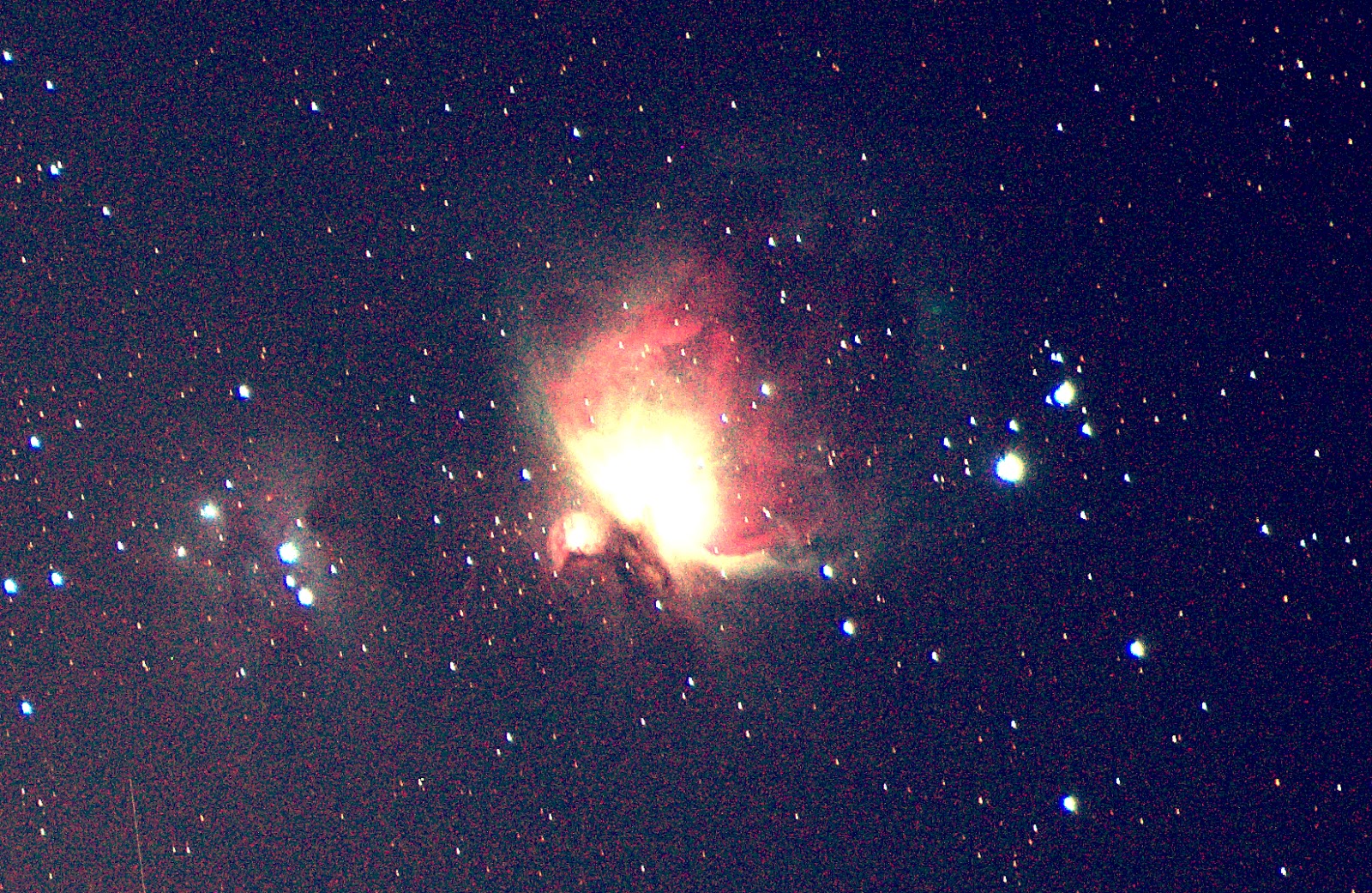
M42 (Orion Nebula).   Single image, 2 min exposure, 200mm f/2.8, ISO 800

NGC2024 (Flame Nebula) and IC434 (Horsehead Nebula)

Original Image with NCG2024 (lower left) and M42 (upper right)

 M42 (annotated by astrometry.net)

IC 434 (annotated by astrometry.net)

Monday, December 17, 2018

December 18, 2018: Comets, Nebulae and a Galaxy

A progress report on my astrophotography adventure.   

I'm slowly overcoming obstacles.  Among them are mechanical stability, vibration control (iOptron Sky Guider Pro),  (delay shutter opening by 2 sec), equatorial mount polar alignment (in order to take longer exposures).

Here are results over the past month:
46P with the Pleiades in the upper left.   90mm Tamron 2.8 lens

46P Annotation from astrometry.net
46P   200 mm f2.8 lens
M31 - Andromeda Galaxy
M42, Orion Nebula

M42 annotation from nova.astrometry.net

NGC 2024  (Flame Nebula) and Barnard 33 (Horsehead Nebula)  The bright star is Alnitak

Track of a geostationary satellite passing Alnilam

Artifact: Aircraft approaching Orion

Maybe artifact:  a strange object in a wide angle photo of the east

Cropped image of the strange object